Choosing among the 2026 top industrial robot suppliers requires more than comparing brand recognition or catalog prices. Global buyers need evidence from real production environments, including automotive lines, electronics plants, warehouses, and food-processing facilities. A reliable supplier should provide documented payload ratings, repeatability data, safety functions, software support, and integration guidance. Small details matter. A robot’s cable routing, controller footprint, and access to replacement parts can affect installation time and operating costs.
This guide examines leading suppliers through a buyer-focused lens. It considers robot arms, collaborative robots, mobile platforms, vision systems, and end-of-arm tooling. The keyword “robot industrial” may describe a broad market, but purchasing decisions remain highly specific. A six-axis robot for welding has different demands from a compact cobot for machine tending. Local service coverage also deserves careful attention. A strong demonstration is useful, yet it cannot replace a verified customer reference or a production trial.
No universal ranking fits every factory. Some suppliers publish excellent technical documents but offer limited regional support. Others provide fast service while their software ecosystems feel less mature. That is worth acknowledging. Buyers should compare total cost of ownership, training quality, cybersecurity practices, spare-part availability, and integration risk. Independent testing, clear contracts, and realistic performance targets can prevent expensive surprises. The best choice is not always the most famous name. It is the supplier that matches your process, workforce, facility, and long-term expansion plans.
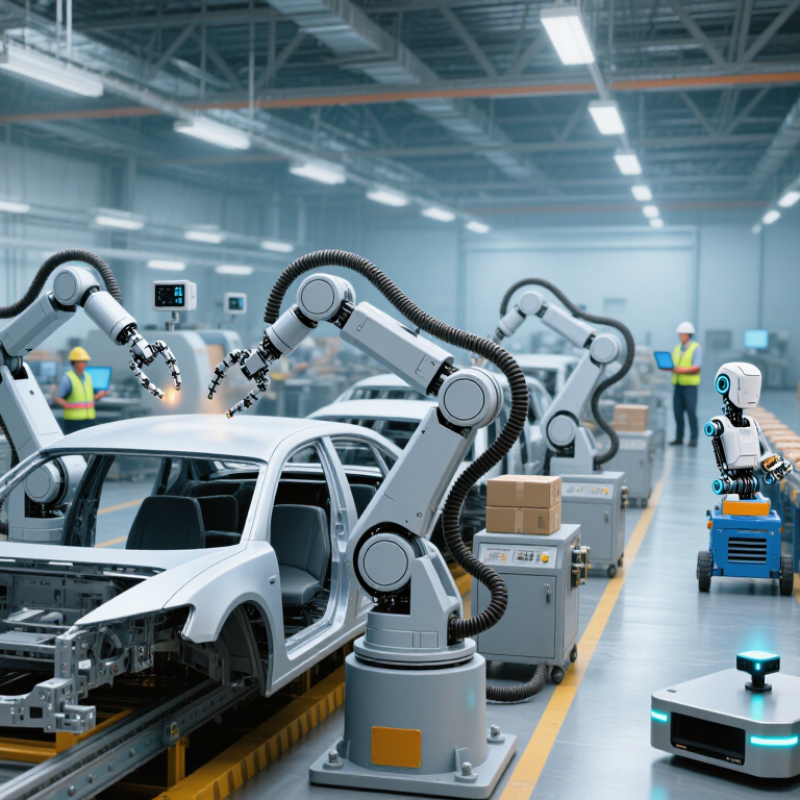
Industrial Robot Suppliers: Market Scope and Buyer Requirements
Industrial robot suppliers now serve automotive, electronics, food processing, logistics, and general manufacturing. Market scope varies by payload, working range, accuracy, and production volume. A small assembly cell needs different equipment from a heavy welding line. Buyers should define the task before comparing supplier catalogs.
A practical assessment starts on the factory floor. Measure reach, cycle time, floor space, dust exposure, and available power. Check whether the robot can handle the actual gripper, fixture, and product weight. Safety functions, enclosure ratings, control compatibility, and regional compliance also require careful verification. Service is local. Spare-part availability matters during a night shift.
Experienced buyers often request application trials using real parts. Promotional cycle times may not reflect tool changes, operator access, or quality checks. Ask for uptime records, maintenance intervals, training plans, and total ownership costs. Integration support can include programming, vision systems, conveyor links, and production data access. A low purchase price may become expensive after installation. Not every repetitive task needs a robot, either. Some processes remain unstable because product tolerances change. That detail is easy to overlook. Suppliers should explain limitations clearly, provide realistic acceptance tests, and document recovery procedures for common faults. Insurance, worker training, and responsible system operation should remain part of the purchasing decision.
Global annual industrial robot installations increased from approximately 373,000 units in 2019 to 541,000 units in 2023, with a record level reached in 2022. For 2026 sourcing decisions, buyers commonly evaluate production capacity, regional service coverage, system integration capability, safety compliance, total cost of ownership, delivery lead time, and after-sales support.
Source: International Federation of Robotics, World Robotics reports. Figures represent estimated global annual industrial robot installations.
Industrial robots now serve distinct production problems, not one universal workflow. The International Federation of Robotics reported 541,302 industrial robot installations worldwide in 2023. Its World Robotics 2024 report also recorded about 4.28 million robots operating globally. These figures show scale, but not suitability.
Articulated robots provide several axes and broad reach. Plants commonly use them for arc welding, spot welding, painting, palletizing, and machine tending. SCARA robots deliver fast horizontal movement, making them suitable for electronic assembly, screwdriving, and small-part insertion. Delta robots use lightweight parallel arms for high-speed sorting and packaging. Their performance can drop when products vary widely in shape.
Cartesian robots move along linear axes. They offer predictable positioning for CNC loading, dispensing, and three-dimensional handling. Collaborative robots support people near shared workspaces, often handling inspection, light assembly, and packaging. However, “collaborative” does not automatically mean risk-free; safety validation must match the actual tool, payload, and process. Autonomous mobile robots move materials between stations, but they are usually classified as mobile platforms rather than fixed industrial robots.
Interactivity Analysis has reported continuing growth in robot demand across manufacturing, while IFR identifies automotive and electrical and electronics production as major installation sectors. Buyers should compare payload, reach, cycle time, repeatability, ingress protection, integration effort, and operator training. A robot that looks fast in a demonstration may lose efficiency beside an unreliable feeder. Real production trials matter. Data sheets can hide the difficult parts.
How to Evaluate Global Robot Suppliers in 2026
Global robot buying is no longer a simple price comparison. The International Federation of Robotics reported 541,302 industrial robots installed worldwide in 2023, with more than 4.28 million operating units. This installed base shows strong demand, but it also exposes a practical issue: support capacity matters as much as hardware. Evaluate each supplier’s regional technicians, spare-parts inventory, training process, and response time. Ask for service records, not polished promises.
Technical fit should be tested on your actual production line. Compare payload, reach, repeatability, cycle time, protection rating, controller compatibility, and vision integration. A robot that moves quickly in a demonstration may slow down beside a conveyor, safety fence, or welding fixture. Request a documented acceptance test using your parts. Include energy use and maintenance intervals in total-cost calculations. The ISO 10218 safety framework and ISO/TS 15066 guidance can help structure risk reviews for industrial and collaborative applications.
Financial stability deserves equal attention. Check warranty terms, software support periods, cybersecurity controls, and the availability of replacement controllers five years later. Industry surveys often highlight labor shortages as a reason for automation, yet training gaps remain common. That risk is easy to underestimate. I would also score supplier transparency, including disclosed failure rates and realistic delivery schedules. Perfect projections are suspicious. A small pilot, measured for six to eight weeks, may reveal cable wear, programming delays, or operator resistance before a global rollout.
| Evaluation Dimension | Recommended 2026 Buyer Benchmark | Typical Industrial Robot Capability | Evidence to Request from a Supplier | Suggested Weight |
|---|---|---|---|---|
| Robot Portfolio Coverage | At least three relevant robot types for the target application | Articulated, SCARA, delta, collaborative, or mobile robot platforms | Current product catalogue, technical datasheets, lifecycle status, and replacement policy | 10% |
| Payload and Reach Fit | Rated payload should exceed the complete end-of-arm tooling and workpiece mass with an engineering safety margin | Small handling robots commonly cover a few kilograms; heavy-duty articulated robots can exceed several hundred kilograms. Reach commonly ranges from under 1 m to more than 3 m. | Payload-versus-reach charts, wrist-load diagrams, inertia limits, and application calculations | 12% |
| Repeatability and Accuracy | Repeatability specification must match the process tolerance, not only the marketing headline | Many industrial robots publish repeatability in the tenths-of-a-millimetre range; high-precision assembly platforms may specify tighter values under controlled conditions | ISO 9283 test results, accuracy data, calibration procedure, temperature conditions, and test payload | 10% |
| Cycle Time and Availability | Validated cycle-time result on the buyer’s actual part, tooling, path, and safety configuration | Cycle time varies substantially by robot type, payload, motion profile, controller settings, and peripheral equipment | Run-off test, takt-time study, mean time between failures, preventive-maintenance schedule, and spare-parts plan | 12% |
| Safety and Compliance | Documented risk assessment and compliance pathway for the destination market | Industrial robot systems are normally assessed with safeguarding, emergency stops, restricted spaces, and application-specific risk controls | Declaration of conformity, risk-assessment template, safety-function data, validation records, and applicable local certifications | 14% |
| Environmental Suitability | Protection rating and environmental options must be matched to dust, water, oil, chemicals, temperature, and wash-down requirements | Robot protection levels differ by joint, cable package, mounting position, and model; IP ratings are defined under IEC 60529 | IP test documentation, operating-temperature range, humidity limits, cleanroom or food-grade options, and cable specifications | 8% |
| Controller and Connectivity | Native support for the plant’s required industrial networks and data architecture | Common integration requirements include industrial Ethernet, digital and analogue I/O, safety I/O, robot programming interfaces, and production-data access | Supported protocols, API documentation, PLC compatibility list, software-version policy, cybersecurity controls, and remote-access process | 10% |
| System Integration Capability | Supplier or certified integrator can deliver the complete cell, not only the robot arm | Typical systems may include grippers, vision, conveyors, welding equipment, fixtures, safety fencing, and machine interfaces | Reference projects, application engineering resources, factory-acceptance-test procedure, and responsibility matrix | 10% |
| Global Service and Support | Local technical support, documented response times, and accessible critical spares in the operating region | Support quality depends on regional service coverage, technician training, spare-parts logistics, and remote-diagnostics capability | Service-location map, support hours, SLA terms, escalation process, spare-parts lead times, and training programme | 10% |
| Total Cost of Ownership | Evaluate purchase price together with integration, energy, maintenance, software, tooling, training, and downtime costs | The lowest equipment price does not necessarily provide the lowest cost per completed part | Five- to ten-year cost model, warranty terms, consumables, licence fees, energy data, maintenance intervals, and end-of-life policy | 10% |
| Sustainability and Supply Resilience | Documented supply-chain continuity and measurable environmental information | Relevant factors include energy consumption, component availability, repairability, packaging, export controls, and production-site diversification | Environmental product data, supply-continuity plan, critical-component risk assessment, repair policy, and business-continuity documentation | 4% |
| Total Evaluation Weight | 100% | |||
Note: Capability ranges are general market benchmarks rather than specifications for any particular supplier or model. Final selection should be based on application testing, technical documentation, safety validation, total cost of ownership, and local service capability.
Industrial robot sourcing in 2026 requires a regional and industry-specific view. According to the International Federation of Robotics’ World Robotics 2024 report, manufacturers installed about 541,000 industrial robots worldwide in 2023. Asia accounted for roughly 70% of new installations, while Europe and the Americas followed with smaller shares. This distribution reflects production scale, labor costs, engineering capacity, and government-supported automation programs.
Regional demand changes by industry. Automotive plants typically need high-payload arms, welding systems, and precise vision inspection. Electronics factories often prioritize compact robots, cleanroom compatibility, and fast cycle times. Food, pharmaceuticals, and logistics require easier cleaning, flexible changeovers, and strong safety documentation. Interact Analysis has reported continued growth in logistics automation, especially where warehouses face labor shortages and rising order volumes. The right supplier must support local integration, spare-parts access, cybersecurity, and operator training.
Numbers help, but they can mislead. East Asian installations may look impressive, yet a smaller European factory could demand more complex compliance support. That difference matters. Buyers should compare payload, reach, repeatability, uptime, software openness, and five-year service costs. The IFR data also shows that robot density varies widely between economies, so national averages cannot predict every facility. A practical assessment should include production layout, maintenance skills, safety risks, and expected product changes. I would not select a supplier from rankings alone. Factory trials often reveal awkward programming, slow service responses, or costly integration gaps. Those details are easy to miss.
In 2026, global robot purchasing should begin with production evidence, not attractive catalog numbers. A supplier must show cycle-time tests using materials similar to yours. Ask for payload calculations, reach diagrams, and accuracy data under real operating temperatures. A low purchase price can become expensive after tooling changes, training delays, and spare-part shortages. Keep assumptions written down.
Integration Integration often decides whether a robot creates value or interrupts production. Confirm who designs the gripper, vision system, guarding, software, and factory connections. Request a staged acceptance test before shipment. During commissioning, operators should practice fault recovery, not only normal production. Small details matter, such as cable routing near moving axes and access to grease points. I have seen projects fail because the robot worked well, but the surrounding workstation did not.
Long-term support Service quality needs measurable promises. Check response times, remote diagnostic methods, technician coverage, and critical-part stock in your region. Training should include maintenance staff, supervisors, and night-shift operators. Long-term support also requires software update policies, cybersecurity controls, manuals, and documented change procedures. A supplier that avoids clear answers deserves caution. Still, buyers should examine their own weaknesses. Our maintenance records may be incomplete, and production forecasts may be optimistic. Build a support plan around verified downtime data, then review it after six and twelve months. Short-term success is not enough.