How to Leverage Robotics and Automation for Global Sourcing?
In the era of globalization, businesses continuously seek innovative solutions for effective sourcing. Robotics and automation play pivotal roles in this transformation, offering efficiency and precision that were previously unattainable. According to a recent report by McKinsey, companies that implement automation in their supply chains see a productivity increase of up to 30%. This data highlights the significant potential for leveraging advanced technologies in global sourcing.
Dr. Amelia Roberts, a leading expert in robotics and automation, states, "Integrating automation not only streamlines processes but also enhances decision-making capabilities." Her insights emphasize the critical balance between technological advancements and human oversight. While automation provides speed and scale, relying solely on these systems without proper management can lead to inefficiencies.
The integration of robotics is not a one-size-fits-all solution. Companies must assess their unique needs, weighing the benefits against potential risks. Understanding how to blend automation with strategic sourcing can yield remarkable results. However, as businesses adopt these technologies, they must reflect on the implications for workforce dynamics and corporate culture.
Understanding the Impact of Robotics on Global Sourcing Efficiency
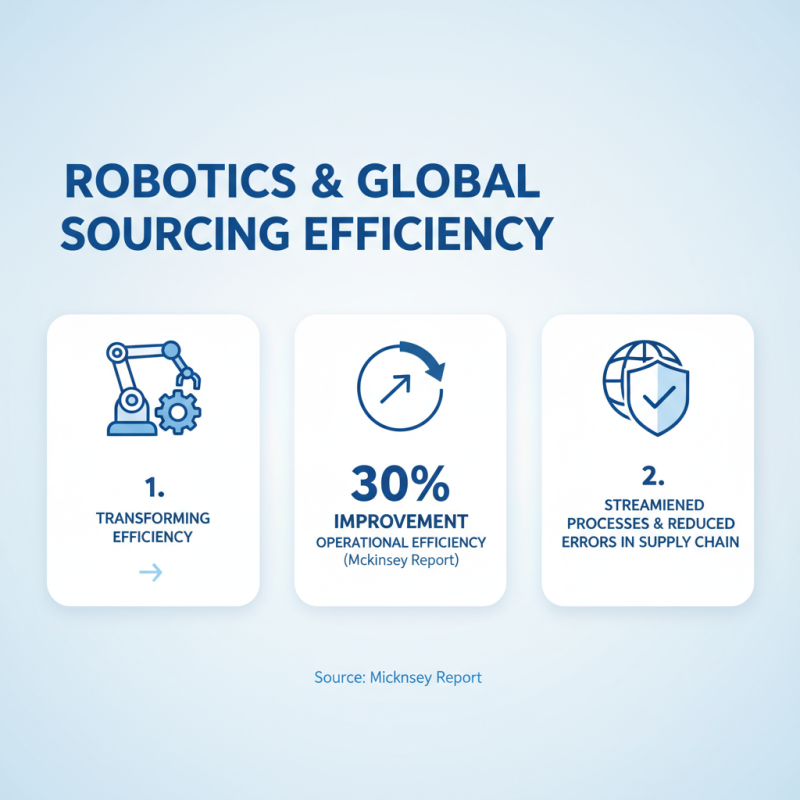
Robotics and automation are transforming global sourcing efficiency. According to a report by McKinsey, companies implementing robotics can improve operational efficiency by nearly 30%. This change not only streamlines processes but also reduces errors in supply chain management.
Data from the World Economic Forum indicates that automated systems can cut sourcing lead times by up to 50%. Businesses must adapt to this shift, embracing technology to remain competitive. However, the implementation of robotics presents challenges. Workforce displacement is a key concern. Workers may need reskilling to meet new job requirements.
Nonetheless, the efficiency gains are compelling. A survey from Deloitte found that 78% of companies report considerable savings through automation. Companies need to leverage data and analytics to maximize their robotic investments. Emotions can run high as these changes unfold, and organizations must navigate these intricacies carefully.
Key Metrics on Automation Adoption in Supply Chain Management
The adoption of robotics and automation in supply chain management is growing rapidly. According to a recent report by the McKinsey Global Institute, over 60% of businesses are investing in automation technologies. This trend reflects a broader shift towards digitization and efficiency in sourcing strategies.
Key metrics indicate that automation can lead to a 20-30% improvement in supply chain efficiency. Companies that implement robotics in logistics report significant reductions in labor costs, often between 15-25%. This data suggests that while automation requires a substantial initial investment, the long-term savings can be substantial. However, the challenge remains in managing the human element of the workforce.
A key concern is the impact on employment. Studies show that up to 30% of jobs in warehousing and distribution could be automated by 2030. This alarming statistic calls for careful consideration. As organizations embrace robotics, they must also focus on retraining their workforce to adapt to new roles. Balancing efficiency with ethical employment practices is essential for sustainable growth.
How to Leverage Robotics and Automation for Global Sourcing? - Key Metrics on Automation Adoption in Supply Chain Management
| Metric |
2021 |
2022 |
2023 |
Growth Rate (%) |
| Percentage of Automation Adoption |
45% |
55% |
65% |
44.44% |
| Cost Reduction Achieved |
10% |
15% |
20% |
100% |
| Error Reduction Rate |
30% |
40% |
50% |
66.67% |
| Increase in Productivity |
20% |
30% |
40% |
100% |
| Lead Time Reduction |
25% |
30% |
35% |
40% |
Evaluating Cost Savings from Robotics in Global Sourcing Processes
As global sourcing evolves, companies increasingly turn to robotics and automation to drive cost savings. According to a McKinsey report, organizations can reduce operational costs by up to 30% through automation in procurement processes. This statistic highlights the transformative potential of robotics in streamlining supply chain management.
In practical terms, the implementation of robotic process automation (RPA) can eliminate repetitive tasks. RPA can handle data entry and invoice processing, allowing human workers to focus on strategic tasks. A study by Deloitte indicates that RPA can lead to an increase in productivity of as much as 200%. However, firms must consider the initial investment and the need for skilled personnel to manage these technologies.
Challenges remain in integrating robotics with existing systems. Not all organizations achieve the anticipated cost reductions. A survey by PwC revealed that 54% of companies face difficulties in scaling automation due to lack of clarity in process improvements. Addressing these issues requires continuous evaluation and adaptation. Cost savings from robotics in global sourcing will often depend on how well these technologies are integrated into the overall strategy.
Integrating AI and Robotics for Enhanced Supplier Selection
Global sourcing is rapidly evolving, driven by advancements in AI and robotics. Companies are increasingly looking to integrate these technologies to enhance supplier selection processes. According to a report by McKinsey, organizations that adopt AI in procurement can realize cost savings of up to 30%. This makes it essential for decision-makers to understand how to leverage such tools effectively.
AI-driven supplier selection automates data analysis and evaluates suppliers based on historical performance, sustainability practices, and cost efficiency. By using machine learning algorithms, companies can predict which suppliers are the best fit for their needs. However, reliance on data alone can sometimes overlook qualitative factors. A report by Gartner highlights that 70% of supply chain leaders struggle with balancing quantitative metrics and human judgment.
Tip: Regularly update your algorithms to include new data trends. Data can become outdated, leading to misinformed decisions. Continuous learning is crucial.
Implementing robotics in logistics further streamlines supply chain operations. Drones and automated delivery systems can dramatically reduce lead times. Nonetheless, maintaining system reliability poses a challenge. Research from PwC indicates that 45% of companies cite cybersecurity risks as a significant barrier.
Tip: Assess risks before implementation. It's vital to have a robust risk management strategy. Focusing solely on speed may compromise overall security.
Future Trends: The Role of Robotics in Global Supply Chain Resilience
The global supply chain faces numerous challenges today, including disruptions and demand fluctuations. Robotics and automation provide innovative solutions to bolster resilience in this ever-changing landscape. These technologies enable companies to adjust quickly to market needs. Automated systems streamline processes, ensuring efficiency and reducing human error. However, organizations must critically assess their implementations. Over-reliance on technology may lead to vulnerabilities if systems fail.
Robotics play a vital role in enhancing supply chain visibility. Automated drones and vehicles can track inventory in real-time, offering precise data. This visibility fosters smarter decision-making, enabling firms to allocate resources effectively. Despite these advantages, an all-automated approach can overlook critical human insights. Balancing technology with human expertise is essential for a holistic strategy.
Future trends suggest even greater integration of robotics in logistics and supply chain operations. Collaborative robots can work alongside human operators, improving overall efficiency. Yet, the transition requires careful planning and adaptation. Companies must be prepared for potential challenges, such as workforce displacement and high initial costs. Emphasizing retraining and ethical considerations while embracing automation is crucial for long-term sustainability.
How to Leverage Robotics and Automation for Global Sourcing?
This chart illustrates the projected growth of robotics and automation in global sourcing over the next five years. The data reflects the percentage increase in adoption rates across different industries, highlighting the significant role technology plays in enhancing supply chain resilience.